State report finds no single culprit — only a system that never kept pace
By Miles Layton
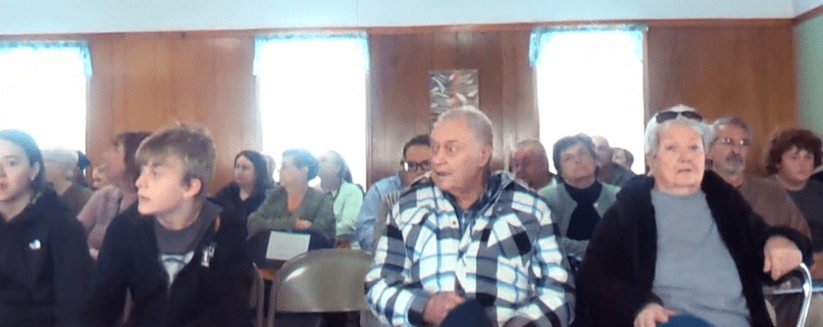
TANGIER ISLAND — The folding chairs filled first. Then the walls. By the time the meeting got underway on the afternoon of March 26, residents of Tangier Island were packed shoulder-to-shoulder inside the Benson Education Building, with dozens more joining by video from the mainland. For an island of fewer than 500 souls sitting in the middle of the Chesapeake Bay, the turnout spoke volumes.
They had come to hear the findings of a state-commissioned Fiscal Distress Report — a document prepared for the Virginia Department of Housing and Community Development and the Commission on Local Government, and developed by the Berkley Group — that, for the first time, laid out in detail what many on the island had sensed for years: their town’s finances were in serious trouble, and the road back would not be short. That report is posted at the end of this story.
While everything may look bleak, God has preserved the island where generations of watermen have raised their families — this is but one more storm; faith will preserve Tangier.
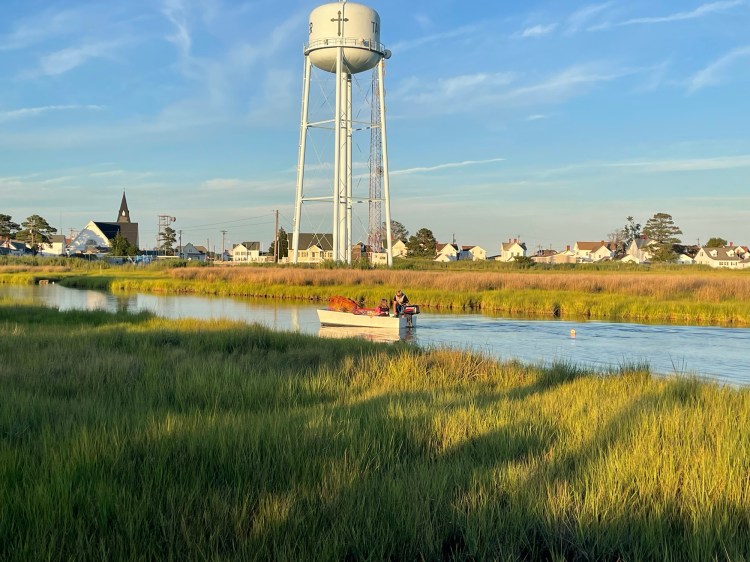
The report arrives after Virginia formally designated Tangier a fiscally distressed locality in 2025, a classification that triggers a structured state-led review and recovery process. What the report describes is not a single scandal or moment of collapse, but something more gradual and more difficult to untangle — a long accumulation of structural weaknesses, limited capacity, and gaps in financial management that compounded over time.
Tangier’s challenges, the report makes clear, stem not from one decision or one administration, but from years of constrained resources, insufficient training, and systems that never fully kept pace with the demands of running a municipal government. Media — if you use information from this story, please credit the town’s website: tangiervirginia.org
A Town Left Behind its Own Bookkeeping
The warning signs, in retrospect, were clear — though for years they appeared in isolation. Tangier had not completed a full financial audit since at least 2010, and regular financial reporting to Town Council had been inconsistent or absent for years. Budgets were not consistently maintained, leaving officials without a clear picture of the town’s financial position. Loan payments fell behind, insurance premiums went unpaid, and required federal reporting lapses placed hundreds of thousands of dollars in funding at risk. Taken together, those conditions describe a government that, over time, lost its grip on basic financial management practices.
State officials ultimately engaged the Berkley Group, through the Commonwealth’s fiscal distress process, to assess the situation and develop a path forward. The resulting report serves as both a diagnosis and a roadmap. Financial responsibilities, it found, were often concentrated in a single position, with limited oversight or redundancy. When the former town manager departed, access to accounts and records became difficult to obtain, complicating efforts to reconstruct the town’s financial history. Accounting processes were inconsistent, and formal policies and procedures — critical for continuity — were largely absent. The report also highlights significant financial control risks, including concerns about unauthorized transfers and incomplete account records, underscoring the need for stronger safeguards and oversight.
None of these issues is unique to Tangier. Small, rural localities across Virginia face similar constraints. What sets Tangier apart is its isolation — a factor that amplifies every administrative challenge. With limited access to professional staff and external support, the town had little margin for error. The financial picture that emerges is tight and fragile. The town operates with limited reserves and ongoing obligations that strain its ability to meet routine expenses. Several core services — including water, sewer, and other municipal operations — require careful management to remain sustainable.
A Government Running on Limited Capacity
Tangier operates under a council-manager form of government, but the report notes that the town has struggled with staffing and administrative continuity. Elected officials, many without formal training in municipal finance, have had to take on responsibilities typically handled by professional staff. Historically, the town relied heavily on a single manager for financial and operational knowledge — a structure that left the organization vulnerable when that person left. The report emphasizes that, without formal systems, training, and sufficient staffing, even well-intentioned leadership can struggle to meet increasingly complex financial and reporting requirements.
Numbers in Dispute
A period for public comment followed the Berkley Group’s presentation, and the exchanges that followed added important texture to the state’s findings. Normand St-Pierre, a current member of the Tangier Town Council, raised several pointed concerns about the budget figures underlying the report. The Berkley Group, he noted, had worked from the initial budget approved in August 2025 — not the revised budget presented to the Town and approved in January 2026. St-Pierre had flagged last August that the financial records available at the time were incomplete, resulting in what he described as many guesses. Where the August budget projected a surplus of $5, the revised January budget projects a deficit of nearly $100,000.
St-Pierre also drew a distinction that carries real weight for how the town’s finances are understood: the budget is built on cash accounting rather than accrual accounting. That difference, he said, distorts the picture for the fuel dock enterprise, which shows an apparent deficit of $49,526. Under cash accounting, payments for fuel purchased — but not paid for — by the prior administration, totaling more than $200,000, are being absorbed in the current fiscal year. On an accrual basis, he said, the fuel dock would net a positive $70,000 this year, even after absorbing a $22,000 loss from a fuel cross-contamination accident last summer.
St-Pierre made clear he was not disputing the severity of what the town faces. The financial issues, he said, are acute and will require outside help to achieve positive cash flow in the very short term. His point was that the scale of the challenge, while real, is more complicated than any single set of figures can capture — and that the burden bearing down on Tangier is, by any measure, extraordinary.
“This Town cannot repay hundreds of thousands of dollars in long-term loans used to refurbish an obsolete wastewater treatment facility that is being held together by duct tape, compounded with $300,000 (minimum) of unpaid invoices left by a prior administration, combined with $100,000 in certificate of deposits that apparently have vanished, compounded by unpaid federal, state and employment taxes from prior years,” St-Pierre said. “It just cannot be done, most definitely in a reasonable amount of time by a resident population of about 300 people living on an annual household median income of around $33,500, which is about a third of the State of Virginia median household income of roughly $97,000.”
Vice Mayor Elizabeth Thomas offered a more measured assessment of the day’s proceedings.
“We felt the meeting went very well,” she said. “Council is grateful for all that the Berkley Group and Commission on Local Governments have done to move the Town of Tangier forward.”
A Roadmap Out
The Berkley Group’s report lays out a phased recovery plan focused first on stabilization, then on rebuilding capacity. Initial steps include restoring regular financial reporting, strengthening oversight, securing financial systems, and addressing urgent obligations. Longer-term recommendations call for hiring or contracting experienced municipal management support, adopting formal financial policies, and expanding training for both staff and elected officials. The report is explicit on one point: Tangier cannot address these challenges alone. Sustained external support from state and regional partners will be necessary to achieve long-term stability.
If the March 26 meeting offered any indication, residents understand the stakes. The crowd that filled the room — and extended beyond it as more than 30 people watched virtually — reflected a community paying close attention to its future. The report itself notes that recovery will require not just technical fixes, but transparency, shared understanding, and sustained commitment.
A Different Kind of Storm
Tangier Island is no stranger to hardship. For generations, residents have faced environmental pressures, economic shifts, and geographic isolation. The crisis outlined in the Fiscal Distress Report is different. It did not arrive suddenly, but accumulated over time — in missing reports, outdated systems, and limited capacity — until it demanded attention.
The path forward will not be quick. The report outlines significant work ahead: rebuilding systems, strengthening governance, and aligning resources with reality. But it also provides something the town has not had in years — a clear framework for moving forward. For Tangier, the challenges are substantial. The systems will need to be built, in many cases from the ground up. But the blueprint now exists — and, judging by the turnout on a March evening, the community is ready to engage with what comes next.
 Tangier Island, Virginia