BY MILES LAYTON
TANGIER — The movie “Been Here Stay Here” was as much a prayer as it was a call for help to save Tangier Island.
The movie about the people, places and plight of Tangier, an island in crisis because of wave erosion and sea level rise, was shown to the Island’s residents on Saturday night for the first time since its release in April.
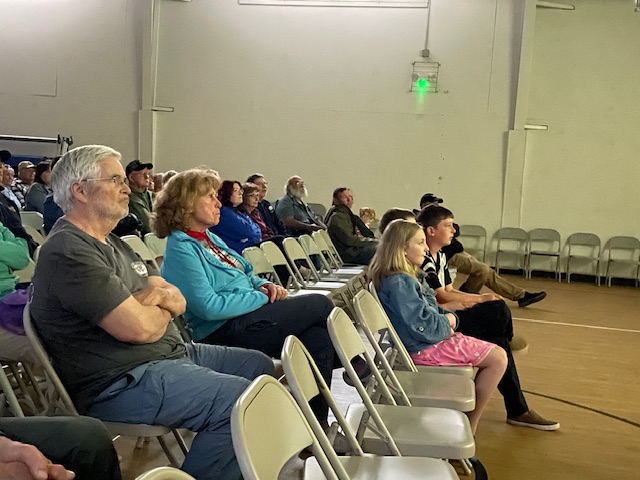
The documentary “Been Here Stay Here” featured two showings Saturday evening at the Tangier Recreation Center — the first time many folks had seen the movie about their community.
The film accurately portrays the island’s 400 souls—many familiar faces, too many to name in this story. To be candid, this is not one of those productions where the film crew grabs a couple of quotes, makes a few references to global warming, and then moves on, leaving a bad taste in people’s mouths with a negative portrayal of Tangier.
Instead, Been Here Stay Here is a positive and thought provoking documentary about the citizens of Tangier who are sounding the alarm on climate change. Director/Producer David Usui’s film captures the essence of a community through the lenses of young and old alike.
A lifelong waterman, Mayor James “Ooker” Eskridge opens the movie by being on the water and making bird calls to illustrate how close to nature the island is, nestled in the heart of the Chesapeake Bay. Throughout the movie, Eskridge, 65, shares unscripted moments that testify to his strong beliefs about what’s happening to the hometown and the importance of “God, family, community, and government” – in that order.
In the movie, a German film crew asked Eskridge about the crisis threatening the tiny island. Surrounded by familiar faces, Tangier’s wise old men, in the “Situation Room” at Town Hall – a place where “a lot of the world’s problems are solved” – Eskridge explained that study after study has shown the need for a seawall; a conclusion that wise watermen long ago came to realize but that “nobody is listening to us.”
“The erosion problem is something larger than we can tackle,” said Eskridge, who gained international fame for talking to former Vice President Al Gore during a CNN townhall-style show that touched on climate change.
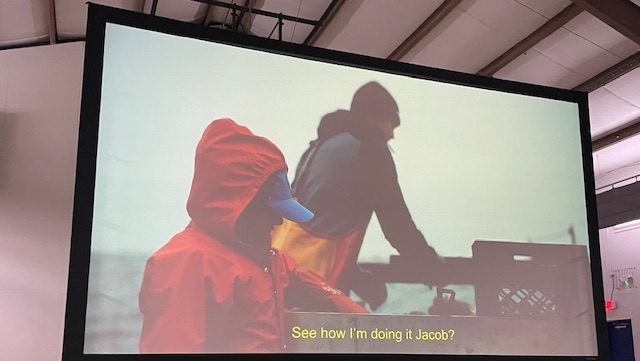
To save their home, an early scene shows a group of kids working and playing together to build a small seawall on the beach using an abandoned skiff, wooden sticks and packed sand they had collected in plastic buckets. Later in the movie, a scene shows a cloudy, almost foreboding day with waves battering away at their tiny seawall.
As Jacob Parks, 9, watched from the front row with his friends in the crowded Recreation Center, he saw himself on the big screen many times. He craned his head forward at times, laughed, perhaps hid his face in embarrassment when witnessing some of his antics such as eating lots of Halloween candy, and cheered – you could tell that he and his friends thoroughly enjoyed the movie. Through the film, Parks learns the family business – being a waterman – even going solo, tossing crab pots in a tiny skiff within a waterway in the middle of the island known as “The Gut.”
Parks’ role helps tie the film together because he represents the future—an uncertain future unless the island gets the help it needs to build a stone seawall.
Native son Cameron Evans, 24, who was attending Virginia Wesleyan University when the movie was being filmed, shared his insights into life on the island in scenes throughout the documentary. As Evans’ classmates huddled around a fire on the mainland, he explained Tangier’s faith and the importance of home and saving the island. During a scene in a political science class, Evans noted how the border between Maryland and Virginia matters because of how each state handles the impacts of climate change.
Maryland has spent hundreds of millions of dollars to restore nearby Poplar Island, an uninhabited island threatened by the same wave erosion and sea level change as Tangier; however, Evans said the state of Virginia won’t build a seawall to save 400 people. Evans’ point was that Maryland is proactive in its approach to the issues that threaten coastal communities, problems that affect Virginia, too.
“If it works for one state, why can’t it work for the other,” Evans said to his classmates in the movie.
Another scene shows Evans with a photographer, a woman who visited the island with a very nice camera that professional photographers would envy. An ideal place for wildlife photography, Evans and the woman search for the perfect scene to photograph, and they lament the loss of habitat needed for the birds to nest. Fewer birds use Tangier as a breeding ground because the beach is at risk during high tides and major storms.
The audience laughed at one scene when Evans is with a duck hunter – a flock of ducks approaches, and Evans blows into his duck call, and the flock begins to approach. Evans and the hunter, both of whom had been waiting in the cold, fall weather, were happy for just a moment or two until the flock of ducks switched directions and flew away. Darn!
The documentary’s modern-day scenes are interspersed with nostalgic footage from an old news report from the 1970s – A Second Look at Tangier. Broadcast on television, that news story showed what life was like in Tangier then – lots of people, kids playing, and the life of being a waterman.
Though times have changed, as has the size of the Island’s population during the past 50 years, much remains the same for Tangier’s close-knit community, which is filled with caring families and kids able to play and bike wherever they want.
Halloween shows Parks trick or treating, later unwrapping and eating candy while lying on his back on a bridge.
The Fourth of July shows residents celebrating with fireworks, kids laughing at sparklers, and the community embracing the moment.
Another scene shows a group of boys, probably pretending to be soldiers, dressed in camo gear, carrying plastic guns, flashlights, and plotting an assault on some imaginary target on the island.
One boy says, “We need to stick together – we need to find a plan.”
Parks steps into a large, longtime puddle that hadn’t seeped into the ground after a recent rainstorm – symbolic, unscripted scenes like that underscore the film’s message.
A scene with Yvonne Smith, 87, worshipping at Swain Memorial Methodist Church is one of many in Usui’s film that provides a rich tapestry of Tangier’s deep Christian faith—scenes were often interspersed with Scripture read from the Bible by various speakers, including Duane Crockett, a man of deep faith.
These faith-based points of Scripture underscore the film’s purpose of calling attention to Tangier and inspiring a call to action.
“Be like David – he sees the giant but he sees God more.”
Paraphrasing a few passages from Matthew, whether building on a rock instead of sand – all will be well if your spiritual house is in order.
During a sermon at Swain Memorial, a pastor visiting the island noted the thought that’s on many people’s minds as the shorelines shrink year to year, however, the state and federal government remain silent. The Pastor asked, “Are you still awake God, before recognizing that God works on His own time.
In an early scene, a wooden Christian cross is shown; however, toward the end of the movie, that cross had fallen down. Undaunted, Eskridge steps off his boat onto the stone jetty to re-erect the cross at dawn against a peaceful sky.
As the final scenes unfold, a narrator echoes Scripture passages, perhaps from Romans—paraphrasing—that people can’t say they don’t know of the Lord, because they do. Saying that means that people can’t say they don’t know and can’t ignore Tangier’s future because they do know what’s happening and what will happen if they turn a blind eye.
Circling back to Parks, he is crabbing at sunrise as the movie fades to black with the sights and sounds of water, like a crab pot sinking into the dark water.
Community Praises Been Here Stay Here
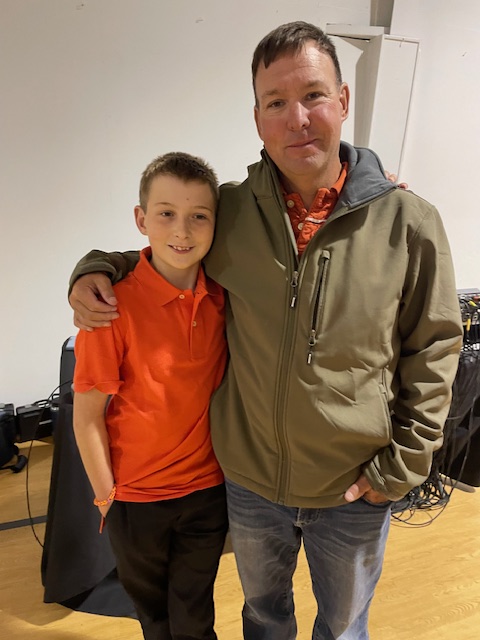
Jacob with his father Allen Parks
Jacob Parks and his father, Allen, watched themselves on the big screen.
“I’m glad nobody asked me for a good autograph because I get nervous doing that kind of stuff because it makes me nervous,” Jacob Parks said.
Parks is probably the most famous kid at Tangier Combined School since, after all, the movie has been seen in Amsterdam, Austin, Baltimore and Washington, DC.
“I feel pretty good,” Jacob Parks said.
When asked if it was fun making the movie, the boy said, “I enjoyed it.”
Allen Parks added, “I loved the movie. I do. Because it portrays three generations, you get the older perspective of older generation. You get the perspective of the present generation Cameron, who is a college student at the time when this was filmend, and then you you see it through the kids’ eyes seeing our community and just the freedom kids have as you saw them running through the streets; Jacob in a boat. In my opinion, there’s there’s no other place in the world like Tangier Island.”
When Allen Parks was asked if the movie would make a difference, be noticed by people who can help, Parks said, “Yes. I do. I’m very optimistic about it. I hope it makes it, you know, all the way up to President Trump. And, he’s a big deal. Hope for our island. I see it helping our island a great deal.”
Crockett did a lot of narration and Evans played a large part in the movie.
“Well, it’s always very awkward when I hear myself talk on a video, but I was glad to be a part of it,” Crockett said. “It’s a project that is so big and so much larger than I am that I was glad to just be a small part of it.”
Evans added, “I’ve been in a few documentaries, but it’s nice to see something in such a large depiction of not just different aspects of the island, but with everything completed into one movie. It’s all there — our way of life through interactions, and it’s definitely neat to see everybody come together and depict that about our island.”
Crockett said God’s work flowed through the film.
“The Lord was certainly praised and honored in it all throughout the movie. You could hear the Scriptures read. You could hear the testimonies given, the prayers that were prayed. Absolutely. I think His word is going to go forth even through this video.”
Evans added, “I think going to cause people to want to come visit and see the nature, see the watermen. Hopefully, it’ll bring financial help to the island through land restoration or jetties. Hopefully, it’ll get the higher ups moving.”
Director’s Take
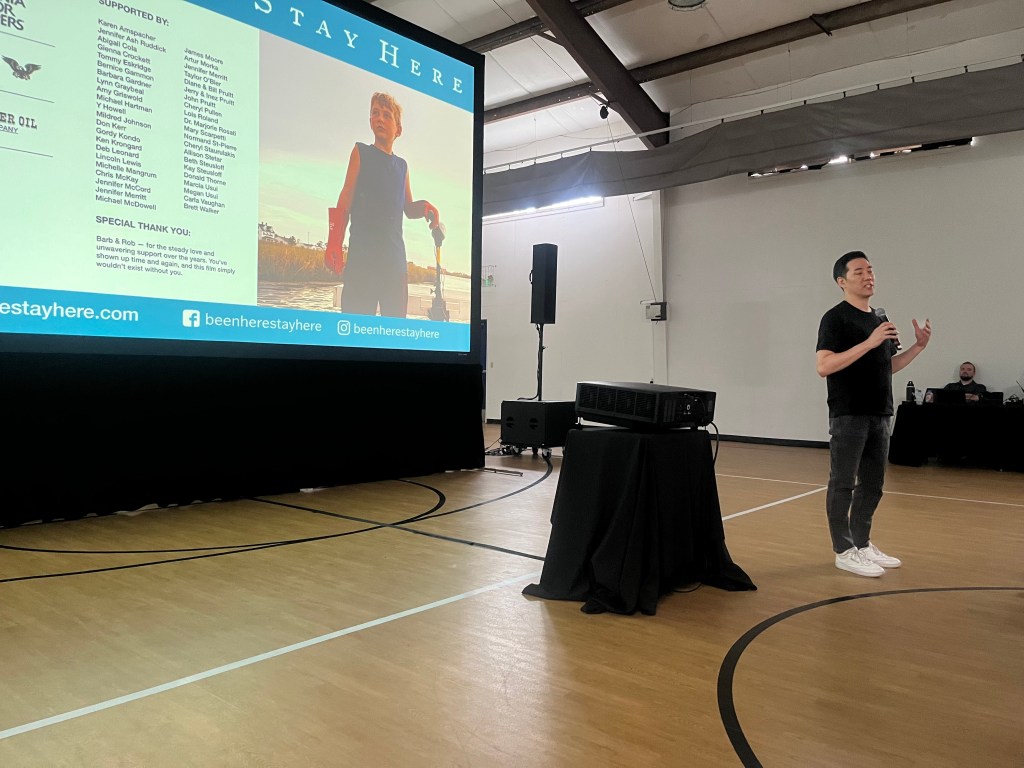
Director/Producer David Usui thanks the people of Tangier for their support at Saturday’s showing of Been Here Stay Here.
Usui has been creating and filming this documentary for more than six years. Living in New York with an international following, how did Usui discover Tangier?
“Tangier’s gotten a lot of exposure over the last 10 to 15 years because of the issues around climate change. I came across the story in 2017. I had never heard of Tangier Island and so I was just immediately struck by it. And I just came down from New York to Tangier for a few days. We went over there and then came back and came back. So for two years, I kept traveling back from New York down here, and the movie was starting to take shape. And then we spent two years here on the island. We would come down from New York and spend a week here every month. We took a monthly trip down here.”
Usui spoke of being inspired, letting the movie flow organically.
“I think there are so many blessings in this project. Things happen that you’re not in control of. There’s part of me that just wanted to make a good movie. You know? It’s so easy to get attached to issues and have goals. I hope that I can make and create a movie that is like a cinematic experience where it feels like you’re immersed in this place for someone who hasn’t been, like, let them travel with their imagination out here, and that it would do them justice. And I think we did a pretty good job of that.”
Usui hopes the film will make a difference and impact others.
“There are a lot of other things that I’d like to do with the film. We’re going to use this as an advocacy piece. We’ve initiated an impact campaign, and so we’ll help raise money for the island to build some of these seawalls that were mentioned in the film. So that’ll happen over the course of the next few years, and we’ll see what happens.”
Usui continued, “Just like making the movie, you kind of just have to listen closely, look closely, and just follow it. Just let it be the guide. Same thing when we’re done with this. I’m starting to meet people who are reaching out to us, having seen the movie, say we’d like to help in this capacity or that capacity. So I don’t necessarily know. I’m just going to let it evolve over time.”
Most of Tangier probably attended the movie showing. When the film premiered in Amsterdam, it was sold out, and the line around the block sold out.
“It’s been awesome. I mean, we had our world premiere in Amsterdam. We had six screenings there, all sold out. It was incredible. I don’t know a single person in Amsterdam. We walk into the theater, and every seat is full. And there was a line outside in case anyone didn’t show up. I couldn’t believe it.’
Much like when the film was shown to viewers at a film festival in Annapolis, the reception in Austin, Texas, was the same way.
“We just screened in Austin, Texas last weekend. That was great. Like, no connection to the Chesapeake Bay. So we’ll see. we just signed a distribution deal so the movie will get out there. We’ll screen it in theaters. It’ll be on, you know, the streamer services probably at the end of the year.”
Dialogue, the scenes – the movie had a powerful chemistry that felt divinely inspired.
“There’s just a lot of magic in the movie. There’s a lot of magic in Tangier, and I don’t know. It almost felt like divine guidance. It’s like, can’t force any of it. The moment with Jacob, the young boy at the end, was actually the first thing we filmed when we got to the island on our first trip, when I didn’t know what the movie would be.”
Usui talked about how the creative process took shape.
“I had already spent two years here, and I was kind of thinking, especially this is like a very loose idea in my mind that I might center the whole film around Cameron’s life. He’s the one who’s in college just because I thought that going through that transition from a full-time native of the island and then moving to Virginia, going to school that he would have some big decisions to make, and that could be interesting. But then once we got to the island, I thought just to be safe, we should diversify this a little bit. I think I need to find a young Cameron in a way. I’d like to find someone who’s essentially Jacob’s age. And there he was with his dad, crabbing. So there was Jacob. Just serendipitous.”
Like a prayer, spirituality infused the film with insight as much as science underscored the grim reality. Usui allowed that creative blend to come into focus.
“I just think that’s how life works. It’s like if we can just get out of the way, let our minds get out of the way, and we just sort of follow, you know, our own impulses, my our instincts. For me, I just slow down. I like to be quiet. I start the morning and I sit. And that’s where I get all my guidance from. I don’t know where it comes from, but it’s bigger than me. I know that for sure.”
Last word goes to Usui who, after the film’s Tangier premier, posted to social media, “Sometimes I’m surprised by joy. Not last night. Not when the entire community that you spent years documenting shows up for your screening and rises to their feet cheering when it’s done. Thank you Tangier for trusting us with your story. Thank you for opening up your homes and churches and lives. I know that trust hasn’t always been easy, or earned. So thank you. I’ve never felt anything quite like it.”
 Tangier Island, Virginia
WatersEdge Sea Kayak club was PROUD to paddle in (from Crisfield, via Smith Island ( ~ 21 miles) for the Tangier premier of the movie! Several of our members are seen in the audience picture above !
LikeLike